The Moon and its influence
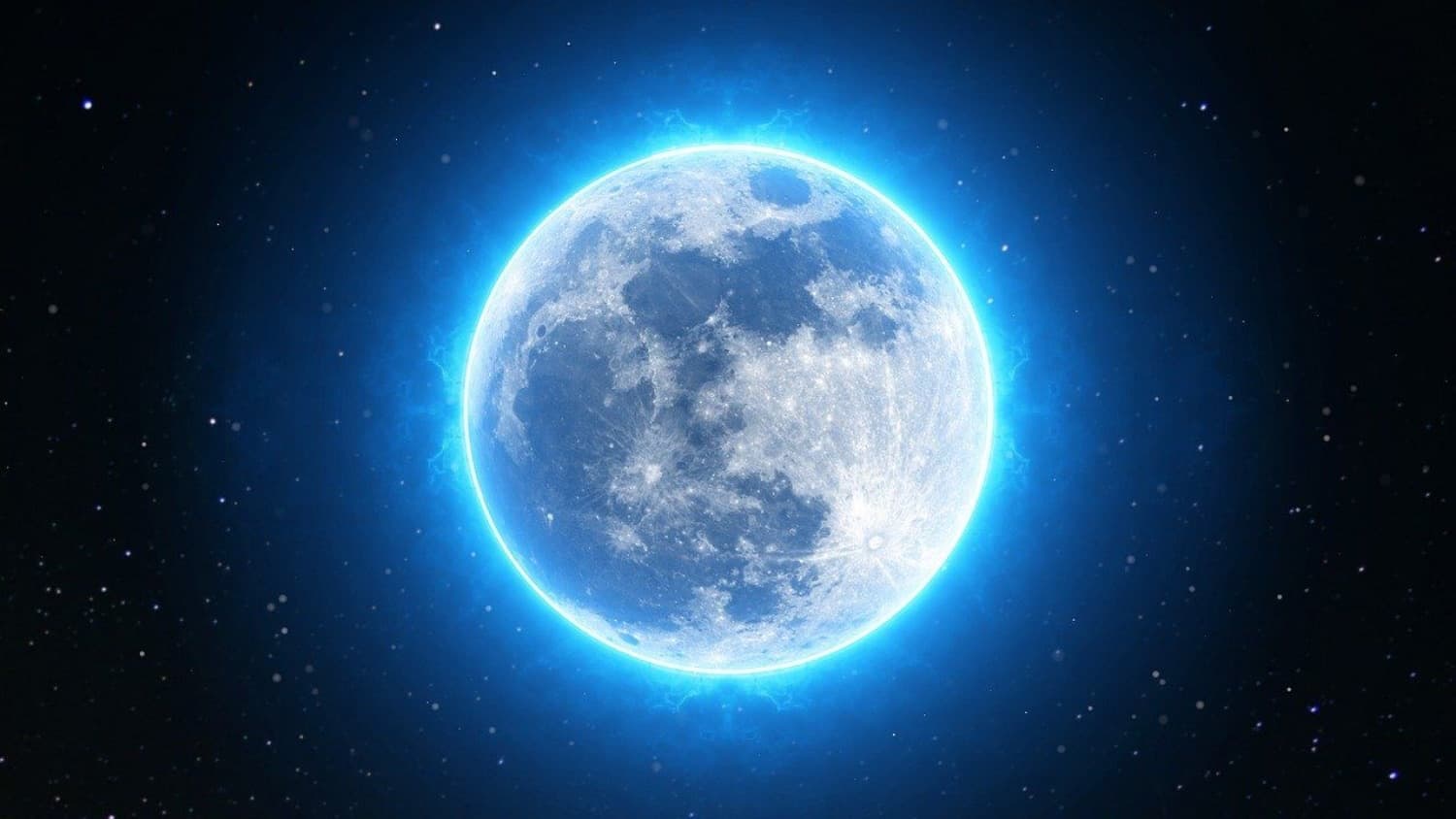
Three scenarios for the formation of the Moon
🌙 The first scenario was that of fission. Just after its formation, the Earth was a liquid mass in relatively fast rotation. Because of centrifugal force, our planet would have ejected a fraction of its mass which would finally have come together to give birth to the Moon.
🌙 The second scenario was that of simultaneous creation: the Earth and the Moon would have formed simultaneously from the same source of dust.
🌙 Finally, the third scenario was that of capture, according to which the Moon would have formed in a different region of the solar system, but would have been captured at a certain moment by the gravity field of the Earth.
In fact, none of these old theories is truly satisfactory. The analysis of lunar rocks has shown that their chemical composition is different from that of terrestrial rocks, in particular as regards the proportion of iron. The Moon cannot therefore be formed solely of matter torn from the Earth and nor could it simply have been born in the same region as the Earth.
Several planetary scientists thus proposed in 1975 a fourth, more complicated scenario for the origin of the Moon. According to them, very early in the history of the solar system, a collision would have occurred between the Earth and another object the size of Mars. This collision would have caused the ejection of an enormous quantity of matter which would have come together to give birth to the Moon.
This last theory can explain all the differences or similarities between the Earth and the Moon, and it is therefore the most widely accepted theory today.
The exploitation of the moon begins with the launch of the first space programmes in 1950. The first step of man on the Moon by the American Neil Armstrong on 21 July 1969, as part of the Apollo 11 mission. Nasa plans to send men back to the moon in 2020.
The Moon’s influence on the tides.
The Tides vary with the lunar attraction, the height of the level of the seas and the oceans, caused by gravitational forces due to the Moon and to the Sun and an inertial force due to the revolution of the Earth around the centre of gravity of the Earth-Moon pair, all of it combined with the rotation of the earth on its axis.
The Moon remains a very present figure in many mythologies and beliefs. It is in correlation with the sun that the symbolism of the Moon shows itself. Their relations, ordering, hierarchy, differ from one society to another. For some: it is the passive female element. It is then associated with female divinities. Thus, the Greek goddess Séléné (Luna for the Romans) has been associated with the Moon. For others, the Moon is a male divinity. The Japanese god Tsu-ku-yo-mi, is associated with the Moon, and his sister A-ma-ter-a-su associated with the Sun. Likewise among the Mesopotamians, where the god Sin is linked to the Moon. This inversion is also present in Nordic, Scandinavian, Latvian mythologies… As among the Indians of Brazil.
It is the observation with the naked eye of the new moon that signals the beginning of the month for Muslims, the Muslim era is based on a lunar calendar and its origin is attached to a historical event which is the exile of the Prophet Muhammad (SWS).
But the Moon has not always had only the good role. In the civilisations of South America, among the Mayas and the Aztecs; it is sometimes given evil signs. Through its changing side, having deceptive appearances, among certain peoples it carries the symbols of falseness and of laziness.
Finally, the variations of shades and of brightness on the surface of the Moon form patterns that people have interpreted differently according to their culture and their imagination: rabbit, buffalo, or man’s face. The astronomers of Antiquity thought that the dark, regular areas were filled with water. They called them “sea”, while the high plateaus, light in colour, were named “land”. These names are still in use today, even if we know that they correspond to no reality.
Today, many mental health professionals think that the cycle of the Moon has an effect on our behaviour. The electromagnetic radiation of the Moon is said to make us more nervous at the time of the full moon, but also more spiritually awake.