Vega of Lyra
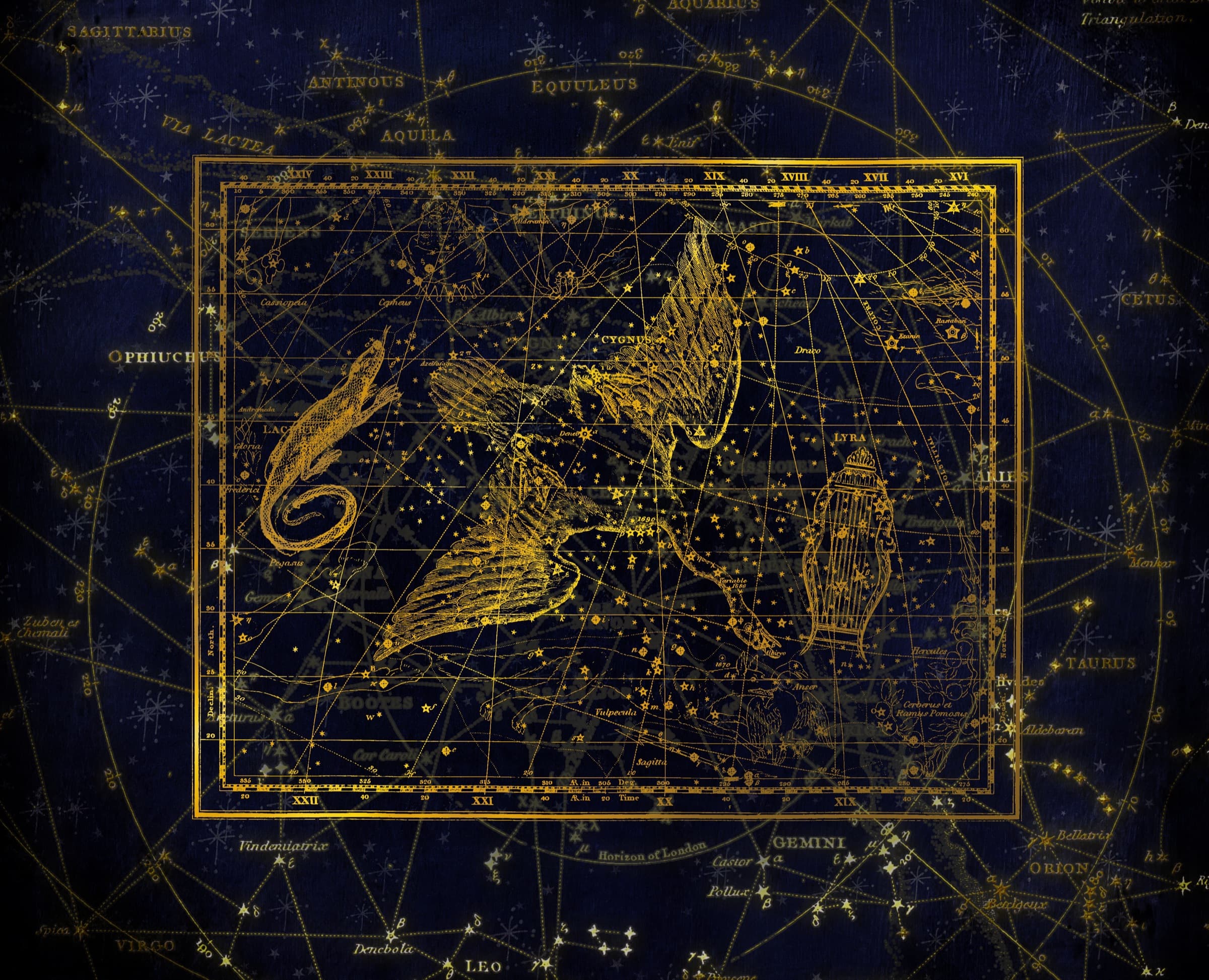
Vega *Alpha Lyrae; a jewel of a star shines with a blue-white brilliance like a diamond. The main star of the constellation of Lyra, it is the first to appear on summer nights, even before the night has turned black.
Vega is close, situated only 25,4 light-years from the Sun. Along with Arcturus and Sirius, it is one of the brightest stars in the sky and in the northern hemisphere it is the second most luminous star after Sirius.
Its energy comes from the fusion of hydrogen into helium. The mass of Vega is about two and a half times that of the Sun. Given that more massive stars use up their hydrogen faster, the lifetime of Vega is estimated at only one billion years, for a current age of about 350 million years.
Vega was the pole star in other eras and around the year 11 750 it will take back the place marking north, because of the precession of the equinoxes. Vega is surrounded by a rotating disc of dust and gas. The temperature of this disc is thought to be -180°C. A dust disc has been observed there which no doubt contains a few exoplanets in formation, and its magnetic field has even been measured. Vega could have an exoplanet the size of Jupiter.
Observations have confirmed that the star itself is astonishing: as it spins very quickly on itself in 12 hours, it has a lenticular shape, flattened at the poles, and these are hotter (by 2300°) and brighter than the equator.
Among the Akkadians, Vega was known as Tir-anna, “The Life of Heaven”
In Egypt, Vega was known as Ma’ât, the Vulture star, goddess of Harmony, of Justice and of Truth. With vulture wings and a feather of truth, that is what she used to determine, which hearts were light enough to rise to Heaven. The role of Ma’ât was to preserve cosmic Order.