Celestial Art
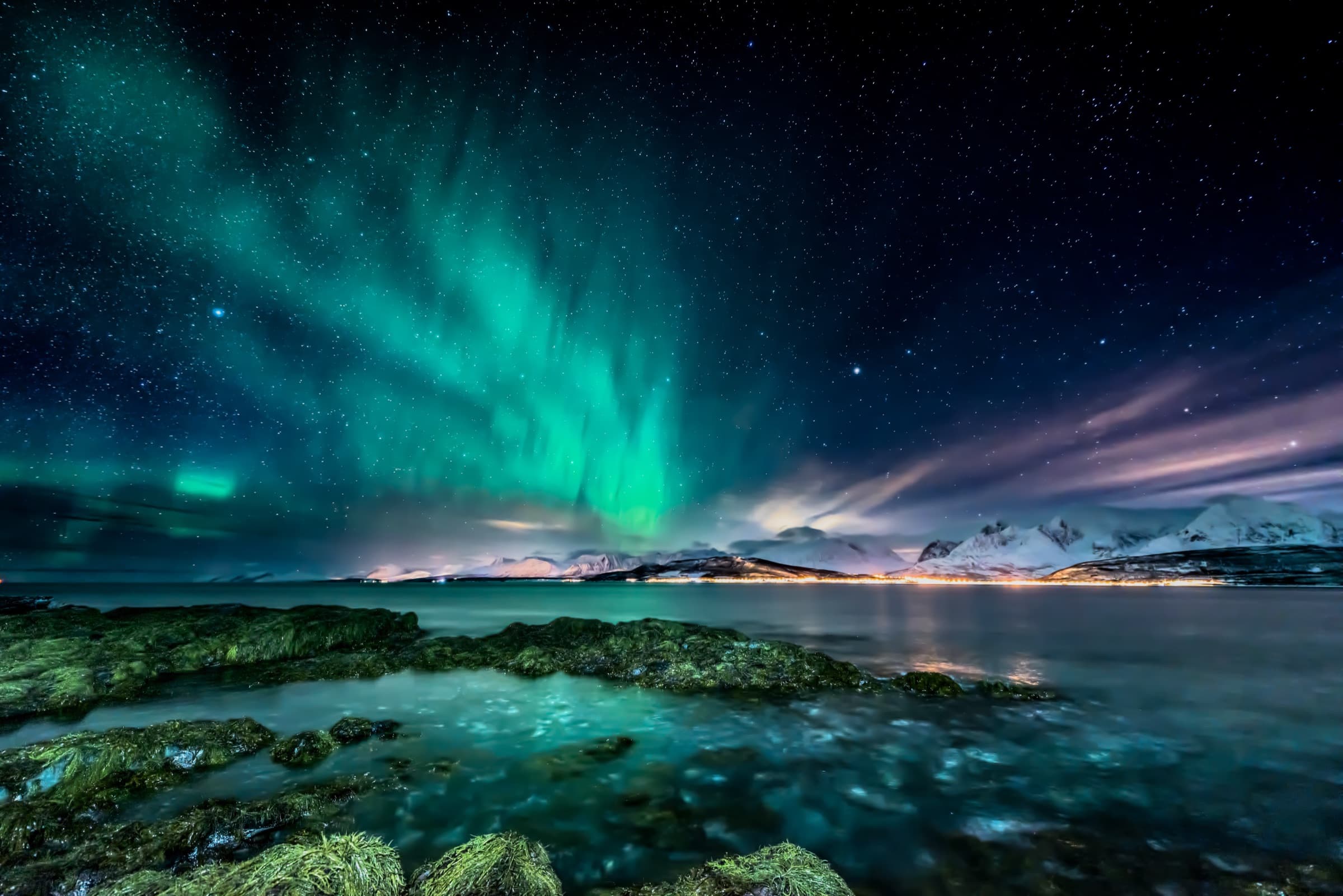
The northern lights (or rather the polar lights) are an astronomical phenomenon that appears in the form of luminous veils in the sky, generally at the poles. They can be observed at night, under a dark sky, which no doubt explains the mythical character long attributed to them, inspiring among other things many indigenous legends. Polar auroras fascinate the imagination, and human beings have been trying to explain the phenomenon for some centuries now. Some northern indigenous peoples, including the Inuit, gave them a spiritual value or else saw them as a revelation for hunters. Until 70 years ago it was also believed that they were the reflection of the Sun on the ice of the Arctic and the Antarctic, but this hypothesis turned out to be false. In fact, polar auroras are the expression of many collisions of charged particles coming from the solar wind and of those of the upper atmosphere of the Earth, under the influence of the Earth's magnetic field (a slightly duller hypothesis, but above all a more complex one).
First of all, to keep it short, the solar wind is a flow of particles coming from the plasma that makes up the solar corona. The solar wind therefore comes from the outermost layer of the Sun, but more precisely, from the upper solar atmosphere. This flow is made up of ionised gas (carrying an electric charge), since it is a plasma. The solar wind is thus essentially made up of charged particles such as protons and electrons. The presence of these particles is due to the very high temperature of the solar corona, which can exceed 1,000,000 K. When the hydrogen and helium molecules that make up the Sun end up in this layer, they undergo intense heating which causes the molecules to ionise, and this gives them an electric charge. What is more, the rise in temperature as the molecules pass from the chromosphere towards the solar corona brings about a rise in the speed at which the particles move, to such a point that they can escape the pull of the Sun (the same principle as gravity, but applied to the Sun). The solar wind therefore refers to this flow of particles escaping from the Sun. During intense solar activity, the quantity of particles ejected by the Sun increases.
The phenomenon is no less spectacular for that, hunters of the northern lights have the privilege of seeing this wonderful message from the meeting point of the elements of the earth and the cosmos.