Luminous Jellyfish
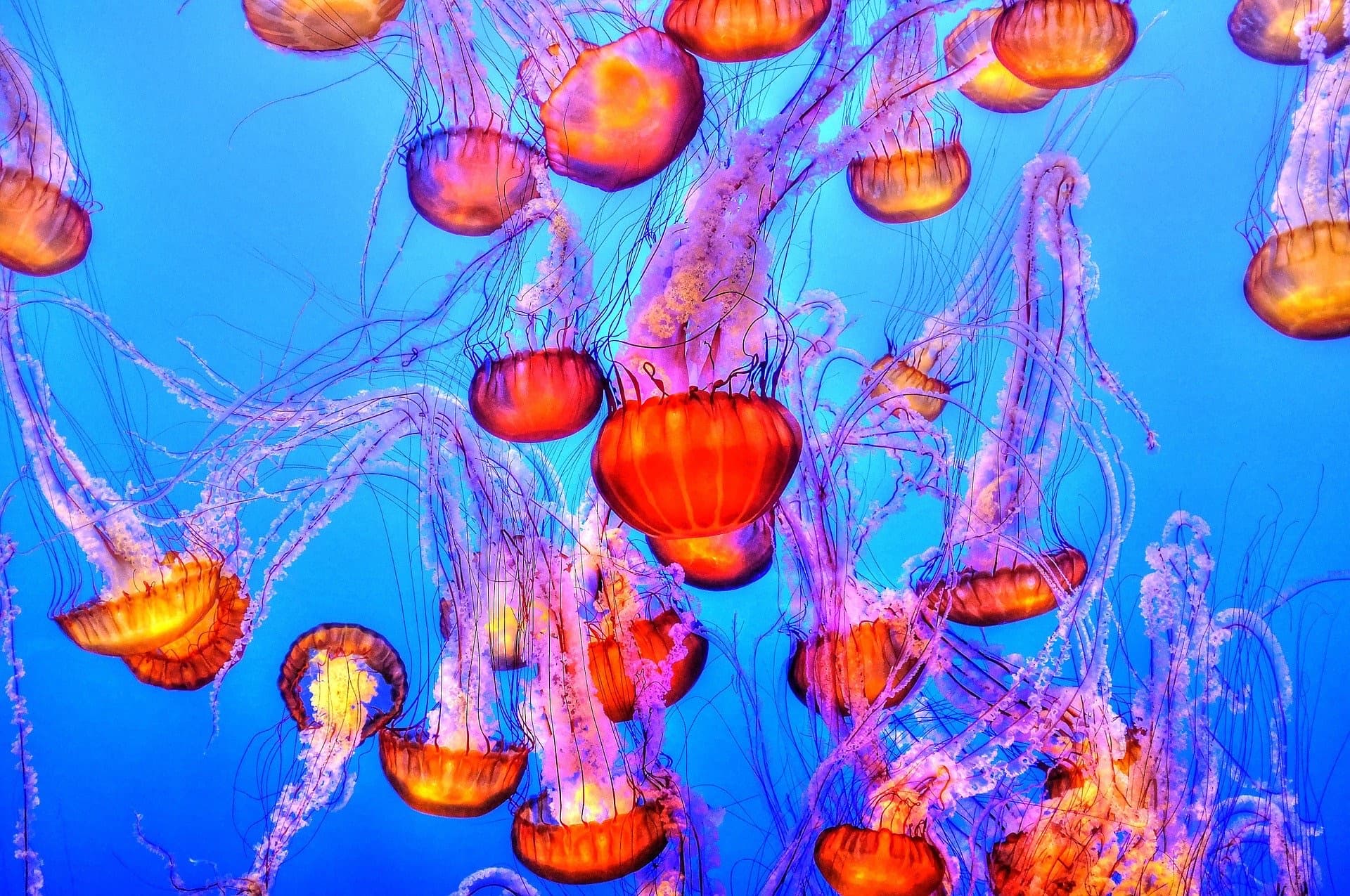
These gelatinous heaps stranded on the sand of the beaches are often considered dangerous animals, with burning venomous stings. But jellyfish are also beautiful and astonishing marine creatures, with an incredible diversity of shapes and colours.
The smallest jellyfish measure only a few millimetres. The biggest reach two metres in diameter and weigh up to 200 kg.
For centuries, jellyfish were largely unknown to zoologists who, because of the simplicity of their structure, close to that of certain plants, readily use a vocabulary borrowed from the plant world to describe them and include them in the branch of the zoophytes (literally plant-animal). Thus, in his first edition (1735) of the Systema Naturae, Linné, as a good botanist, places jellyfish in the order Zoophyta, designating the tentacles as the stamens of the jellyfish (Stamina Medusarum), their oral arms as the pistils (Pistilla)
With their graceful and light body, jellyfish hide their game well, because they are in fact fearsome predators present in a large part of the seas of the Globe. With no brain, no heart, no skeleton and no teeth, jellyfish have developed original weapons to hunt their prey and a unique way of reproducing.
The study of their biology, from anatomy to the functioning of the cells, shows that these animals are considered “primitive”. Their eyes, a concentration of organs, of senses and of sensory neurons that suggest the beginnings of cephalisation, and their muscles (muscle cells). Researchers also recognise in them evolved features such as the segmentation of the body, the production of hormones for nesting and even human-type collagen.
Proliferating today in our oceans because of human activity, jellyfish have crossed the ages. Known and described since Antiquity, Aristotle takes an interest in them and among the hundred or so marine animals he describes, he calls them “cnide”, which means that which stings, specifying that they move in and on the water.
In homage to Aristotle, the naturalists of the 20th century created the phylum of the cnidarians to classify jellyfish, corals, sea anemones…All of which sting.
Four centuries later, Pliny the Elder observes the movements of jellyfish, which remind him of the contractions and the dilations of breathing, and he names them Pulmo marina, “the marine lung.”
This negative perception has hampered the assessment of the ecosystem services provided by these animals, whereas they play a central role in marine biodiversity by preventing the monopolisation of the biomass by extremely high-performing competitors. They take part in the biogeochemical and ecological transfers of nutrients (mainly nitrogen and carbon) from the surface ocean towards the benthos of the deep ocean.
When the environment deteriorates, certain jellyfish make themselves Cysts in which the tissues break down, then, when the environmental conditions improve, the cysts open and within the space of a day these jellyfish are found again, having regenerated their cells and thus managing to pass to the jellyfish stage, which makes it potentially immortal (only biologically)
Jellyfish use light signals, and this is important for their survival. These can serve to attract their prey, to repel a predator, to signal to a partner or to raise an alert. But scientists are still trying to understand how jellyfish use their mysterious “lights”.