Galaxia Lactea
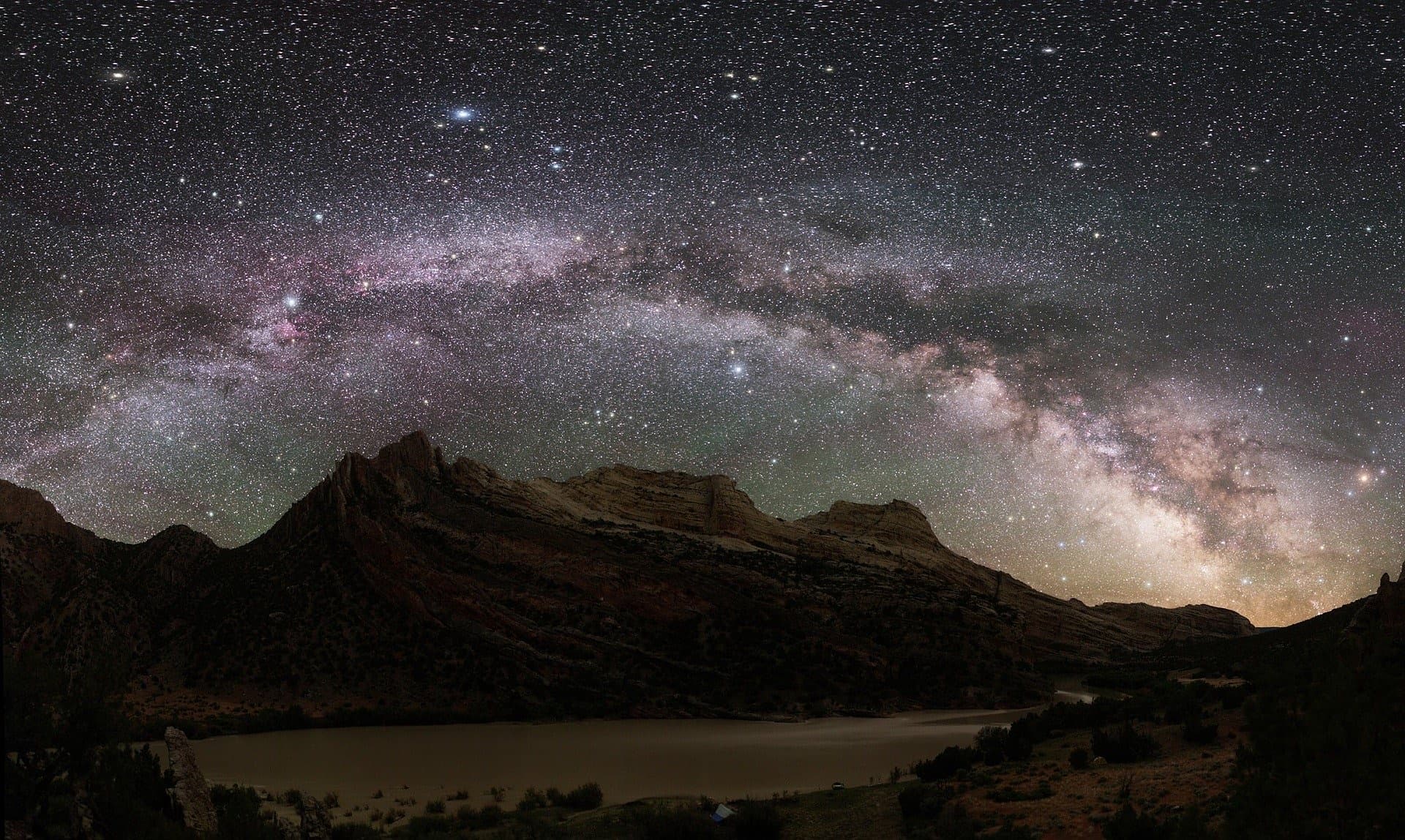
The Milky Way is the second largest galaxy in the Local Group, a cluster of some sixty galaxies measuring 10 million light-years across. Indeed, after the solar system there is our galaxy, the Milky Way, contained within a Local Group, itself part of a set of around a thousand other galaxies, the Virgo Supercluster, which is itself contained, since its discovery in 2014, within an even vaster supercluster named Laniakea.
It is a spiral galaxy containing between 200 and 400 billion stars and at least 100 billion planets. Its diameter is estimated at around 100,000 to 200,000 light-years.
Our Solar System, which is part of it, lies about 27,000 light-years from the centre of the Milky Way, which is made up of a supermassive black hole.
The centre, called the galactic bulge, is swollen by a great density of stars and measures 10,000 light-years across. The galaxy as a whole is surrounded by a halo, thought to be made up of stars, gas and dark matter.
The expression “Milky Way” comes from the ancient Greek “Galaxia Lactea”, which means “path of milk” To understand the origin better, you have to go back into ancient beliefs.
There are indeed many legends linked to our galaxy, including one that comes from Greek mythology.
The story goes that Zeus put his son Hercules to the breast of the goddess Hera while she was asleep. By suckling divine milk, Hercules was to become immortal. Not yet in control of his strength, he pulled so hard that the milk spurted out and spread across the sky in a great trail of milk.
Observing and understanding galaxies populated by billions of stars is a quest that began a very long time ago, ever since man looked at the sky. In 1609, thanks to Galileo, the scientific nature of the Milky Way was established once and for all. The best times to observe the bright galactic centre of the Milky Way, in any part of the world, are between mid-March and mid-October, the “Milky Way Season”.
It is visible to the naked eye from anywhere, as long as there is no city nearby and no light “pollution”. You also need a minimum of patience. It shines faintly and the eye takes several tens of minutes before night vision becomes effective. But the show is worth it.